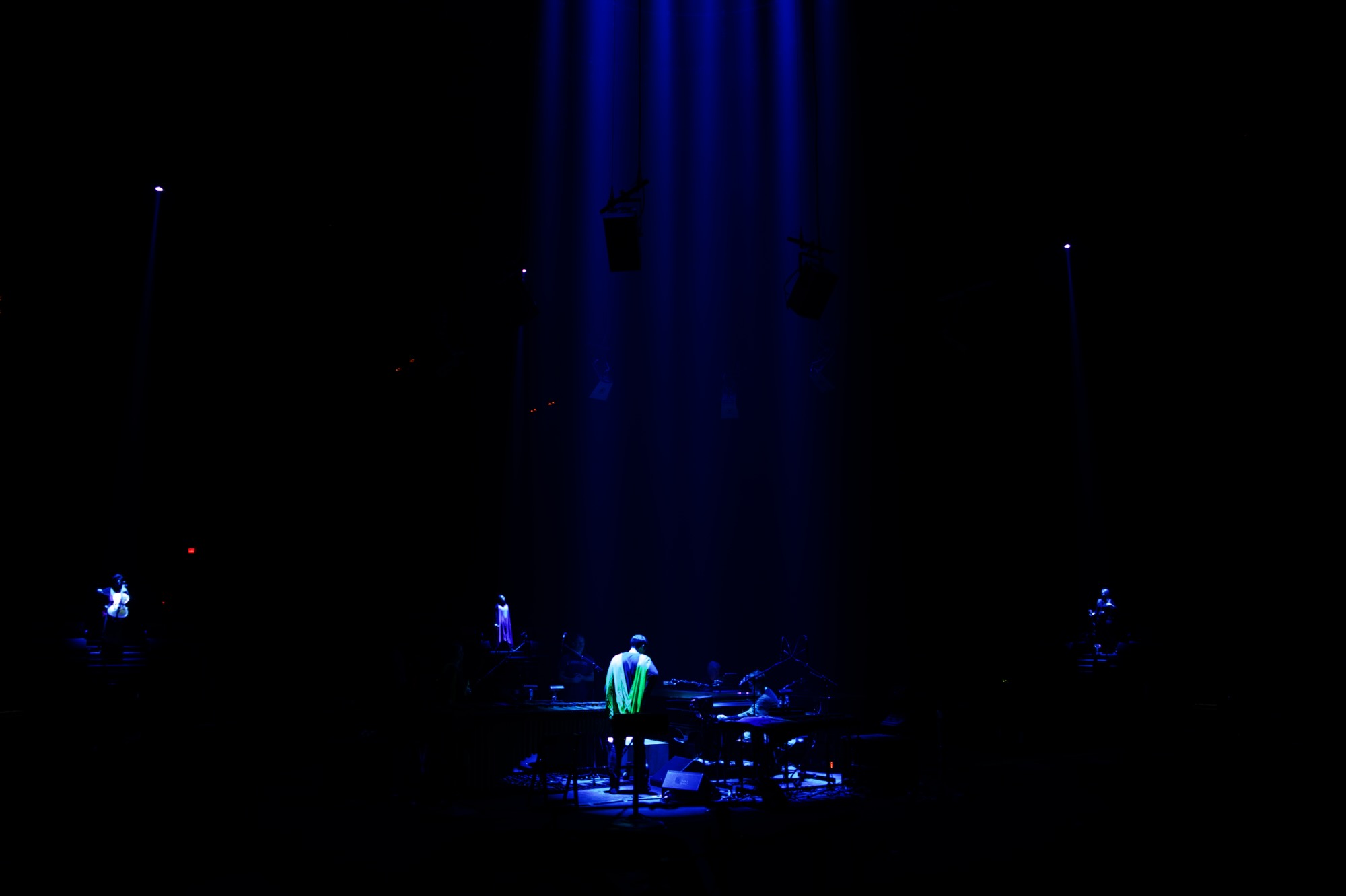
A quick scheduling update: this weekend’s Beacon, NY show with Aaron Diehl has been moved from Sunday to Saturday, Jan 24 due to the impending blizzard.
Music has survived several millennia of societal and political change. But it may not survive you not coming to my several upcoming concerts with fellow pianist Aaron Diehl.
A couple of our collaborations are culminating over the next few weeks. Namely:
Made of Tunes, the concerto I wrote for Aaron which premiered in 2024 in Los Angeles, comes to the Minnesota Orchestra for this all-American New Year’s program, conducted by Teddy Abrams. The piece is likely to become a staple of the season; I’m told Alicia Keys will perform its plaintive second-movement theme just before the ball drops in Times Square next year.
Aaron and I have been steadily chipping away at our two-piano duo show since we debuted it at the Phillips Collection last spring. We’ll be doing a Hudson Valley preview of the program which a couple days later we perform at…
…Carnegie Hall. The program features music by Billy Strayhorn, Thelonious Monk (in extensive new re-workings), Julia Wolfe (the Aretha Franklin-inspired banger my lips from speaking), music from my 2010 album Shy and Mighty, and a couple of other surprises.
Finally, Aaron takes Made of Tunes back out on the road, this time to the Cleveland Orchestra. John Adams conducts the program, which also includes his great new mini-symphony Frenzy.
On Thursday, November 13, I’ll be joining my Mannes colleagues Rebecca Fischer and Jia Kim for a performance of my 2018 Piano Trio. The evening will also feature music by Gubaidulina and Wynton Marsalis, all performed by Mannes faculty. This is a chance to hear some very exciting music played by stellar musicians for cheap as free. Come through!
Bay Area friends: I’m joining Kronos Quartet for an evening of ~spooky~ music this Halloween night (that’s Friday, October 31 for all you heathens). Unforgettable poster, above, by Kronos cellist Paul Wiancko. We’ll be playing a suite from Philip Glass’s score to Dracula, by now a Halloween classic. Here is a short note about what to expect in my opening solo set:
The three composers represented on my Halloween program share a fascination with the dark. I’ve interwoven three nocturnal movements from Leoš Janáček’s On An Overgrown Path (Our Evenings, Good Night!, and The Barn Owl Has Not Flown Away!) with new fantasy-transcriptions of pieces by Thelonious Monk (Crepuscule With Nellie, Misterioso, and Round Midnight). I love how these pieces by two very different composers seem to speak to each other across continents and cultures, their inventive and idiosyncratic languages finding parallel tonal registers and rhetorical flourishes. To cap off the program, we’ll hear the premiere of a new work: a recent birthday gift from my friend Gabriel Kahane, written expressly for the occasion. A Gorey Nocturne (inspired by the late author and illustrator) is an eerie and eventful gymnopédie which follows the entirely fictional character “Timothy Anders” on an unexpectedly paranormal—yet ultimately successful—grocery shopping expedition.
I’ll be joining the faculty for Art Of Piano 2026 at the Banff Centre in Alberta this coming June. Though this program is typically focussed on piano performance, I’ll be accepting a limited number of composer–pianists into my “studio” for the two-week session. There are still very few opportunities for students with this specific focus, so please apply and help spread the word. Applications are open until December 3, 2025.

Playing Glass at La Jolla Summer Music Festival last week, wearing David Kaplan’s tie. Photo by Ken Jacques.
A quick note to say that I’ve put up a provisional 2025–2026 season calendar. I’m particularly excited about further outings of Made Of Tunes in Minneapolis and Cleveland, with Aaron Diehl on the keys. As usual, more events to be announced as the schedule falls into place.
Performing, humidly, at Little Island last month (photo by Rob Davidson). In case you missed it and were hoping for another scenic outdoor piano recital: you’re in luck, because I’ll be playing at Caramoor’s Spanish Courtyard July 24. The following is a brief note I wrote about the program:
⁂
When I’m working to understand a piece of music, I find it helpful to think about its balance of complexity versus simplicity—which aspects operate on which levels, how do they relate to each other, how do they define the piece’s language and structure? My favorite pieces are usually a calculated mix of the two, rather than being all to one side or the other. This dialectic might be a useful way to approach tonight’s program, whose contents might, at first glance, seem only tangentially related.
Robert Schumann’s music is usually associated with a kind of hyper-Romantic emotional complexity, hinging on dramatic contrasts, idiosyncratic forms, and dense webs of personal and literary references. I’ve long admired his Canonic Etudes, in part because they play against these stereotypes so strongly. Composed originally for the Pedalflügel, a special piano fitted with an organ-like foot-operated keyboard connected to the bass register, the Etudes are beautifully understated studies in the contrapuntal possibilities enabled by two extra appendages (they are most often heard today in their four-hand or two-piano arrangements). All six etudes are, in fact, perfect canons, with the canonic voice sometimes at the unison and sometimes at the fifth, for a more fugal effect. Schumann’s steadfast commitment to counterpoint sometimes results in unexpected harmonic twists, yet the music never feels haphazard or underworked. Just beneath the wild Romanticism, Schumann turns out to have been every bit as rigorous a technician as Bach or Brahms; it’s just that he usually chose to emphasize the complexity of other aspects of his music. In the Canonic Etudes, he knew to keep the rhetoric simple: all are short, A‑B-A forms with clearly-delineated and traditionally-phrased melodies and neatly resolved endings, relating to each other in shared attitude and compositional process, rather than any sort of overarching drama or shared themes.
When I composed the suite It takes a long time to become a good composer in 2010, I was thinking about Schumann. The piece is an attempt to fuse some of Schumann’s more radical structural ideas (the telescoping, nesting doll forms of pieces like Carnaval and Kreisleriana) with a pared-down, anti-virtuosic piano language derived from Copland and Stravinsky. The resulting music is, in some ways, less committed to structural rigor than anything I’ve written. I didn’t compose it with an overall through-line or process in mind. Instead, its developmental engine comes from its odd cocktail of jump-cuts and stylistic references jostling against each other. The core of the piece is its long central movement, Everything is an onion, which gradually surrounds a somber passacaglia with buzzing activity before dismantling it (fittingly) into layers. As the piece progresses, it moves generally from the idea of music as “material”—small, abstract chunks of harmony, texture, or figurations—to music as melody, and, finally, song. The effect is a gradual de-tensioning of the structure, a progressively freer interrelation of materials, like falling asleep directly into a strange dream.
It’s been remarked that the Piano Sonata represents Copland at his sparest, most severe, most aspiringly “modernist”; its language is all planes and angles, harmonies stripped to their essence, ornament eliminated. The sense of “placeness” associated with Copland’s music is absent here, or perhaps it places itself in an imaginary realm halfway between the American West and a 1920s Paris salon. The musical texture is notable for its absence of counterpoint, instead often focusing on unadorned melodic lines. Chords seem as though they have big chunks of missing notes, the yawning gaps between their intervals creating startling and uncomfortable dissonances. Tempos change frequently, and phrases fill uneven numbers of bars, cutting each other off without warning. Essentially, Copland has found the reverse balance of complexity and simplicity of Schumann’s; the richness of his Sonata lies in the contrast of its surface and its rhetoric. It communicates complex ideas in admirably clear language. The effect is dramatic, almost in a theatrical sense as if musical material were playing different characters (perhaps it’s not coincidental that the piece is dedicated to the playwright Clifford Odets). Sometimes the music is a dialogue, as it is between the right hand and the left in the second movement, and other times a monologue, in the long, discursive, ultimately tragic arias of the third. In the end, we feel as if we’ve absorbed a story much grander than the piece’s 23 minutes could possibly contain, full of vivid settings, plot twists, intersecting character arcs, and sharply-observed details.

Here’s something hot off the press: a video of last weekend’s performance of The Great Span at Peoples’ Symphony. It’s always a pleasure to play with the Calder Quartet; I love their understated intensity, rhythmic integrity, and technical precision, qualities which apply to this piece particularly well. The venue (new to me) of NYC’s WPA-era High School of Fashion Industries, atmospheric in both spirit and decay, also seemed to suit music concerned primarily with pattern, craft, and links between seemingly distant historical periods.
Many thanks to the Peoples’ Symphony for allowing the use of this recording, captured by Studio42.
The following is a list of upcoming performances. I would be so pleased to play for you at any and all:
The wonderful Calder Quartet are coming from Los Angeles to play The Great Span, a nice meaty quintet I wrote for us to play together in 2023. Also on the program: music by Schubert, Ann Southam, and Debussy.
The complete Glass Etudes in Hamburg and Berlin, played by a stellar lineup of ten pianists.
A solo late show at “The Glade” on Little Island. Come, bring a picnic, maybe a bathing suit? I will be playing a minimal-ish program of Southam, Glass, Andres, Schubert, and a world premiere by Christopher Cerrone.
Solo show at Caramoor’s Spanish Courtyard. Typically, I have decided to play only “the hits”: Schumann’s Canonic Etudes in my own transcription, Copland’s Piano Sonata, and my 2010 suite It takes a long time to become a good composer.
The complete Glass Etudes at La Jolla Music Festival, plus a concert of “New York Composers” the following day, featuring Fiddlehead and Everything is an Onion.
The Blind Banister made it onto three “best albums of 2024” lists (that I’m aware of): The New York Times, NPR, and Gramophone. Since few publications review them now, it’s difficult to gauge a new album’s reception until such year-end deluges are tabulated. In karmic return, I’ll offer a recommendation of my own: Stefan Jackiw and Jeremy Denk’s new recording of the Ives violin sonatas, which I don’t think I’ve ever heard played with such understanding, wit, and—not unimportantly—accuracy.
A couple of my pieces have appeared on friends’ albums over the past few months: most recently Adam Tendler’s sensitive reading of An Open Book, which I wrote for him in 2022 for the Inheritances project. Speaking of long-gestating solo piano projects, David Kaplan’s New Dances of the League of David has finally emerged, worth the wait. It contains some stunningly daring Schumann playing as well as my own trifle Saccades, written for the project in 2014 (!). More ancient history making recent news: an arrangement of Out Of Shape (from 2007’s Shy and Mighty) for two pianos and two electric guitars, recorded by the estimable quartet of Marielle and Katia Labèque, David Chalmin, and Bryce Dessner. I’ve also been working with Bryce recently on a few of his film scores; you can hear my piano playing (and my very own piano) on the soundtracks of We Live In Time, A Good Person, and She Came To Me (catch it on your next Delta flight).
Other news: the long essay I’ve been writing on and off since 2020 on the complete works of Steve Reich will accompany Nonesuch’s 27–CD festschrift, due in March 2025. Think of it as a “listener’s guide” from the somewhat particular perspective of a fellow composer. Grateful to all who made this happen: Bob Hurwitz for asking me to write it, Karina Beznicki and David Bither for shepherding the project along over the years, Sidney Chen, Jake Wilder-Smith and Maya Bouvier-Lyons for their editorial oversight, to Katharine Andres for being, as always, my primary reader and most merciless editor, and of course to Steve for sharing his time, insights, and recollections.
I’ve just yesterday finished one last piece for 2024, which is a hefty solo piano work for Jeffrey Kahane called Simple Secrets. It’s a continuous 25–minute movement with no slow sections; wish him luck! The plan is that we will get to hear it at some point in the 25–26 season; stay tuned.